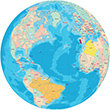
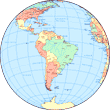
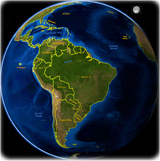
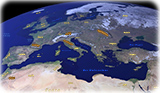
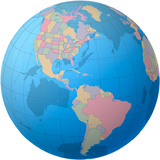
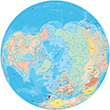
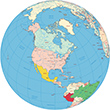
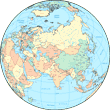
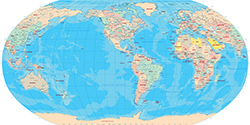
Globes of
Planet Earth are representations or photographs of the Earth as seen
from outer space. In most cases, clouds are removed from the representation, but
some photographs constructed using a set of smaller photographs from the same
angle and scale may also appear cloudless. However, to visualize all regions of
the planet, a planisphere representation is necessary. For this purpose, several
cartographic projections were developed after the discovery of America by
Europeans.
Globes of
Planet Earth are representations or photographs of the Earth as seen
from outer space. In most cases, clouds are removed from the representation, but
some photographs constructed using a set of smaller photographs from the same
angle and scale may also appear cloudless. However, to visualize all regions of
the planet, a planisphere representation is necessary. For this purpose, several
cartographic projections were developed after the discovery of America by
Europeans.
The Planet Earth has an average diameter of 12.7 thousand km, making it the fifth largest planet of the Solar System. Earth is also the third closest planet to the Sun. The Blue Planet boasts a fantastic array of natural beauty, inhabited by humans and a multitude of other animals and plants.
The Portuguese were the first to understand the force of gravity, long before Newton. This allowed them to establish trading posts along the entire West African coast, including southern Africa in the last decades of the 15th century, without fear of falling into outer space.
From the 4th century onward, Christianity spread rapidly across Europe. This was followed by a disinterest in the scholarly works of antiquity in favor of the Bible. Many manuscripts by Greek philosophers were burned. The Iberian Peninsula was invaded and ruled by Germanic peoples. Fortunately, the scholarly works of antiquity were copied and improved by the Arabs, masters of algebra, and Eastern peoples.
In the 8th century, the North African Arabs, or Moors, extended their rule into the Iberian Peninsula. Thus, Portugal and Spain didn't have to wait for the Crusades, like other European countries, to gain access to the knowledge of the ancient Greeks, especially mathematics, which was fundamental to navigation. This greatly contributed to Portugal's pioneering role overseas. From the 15th century to the mid-16th century, the world's best navigators and cosmographers were Portuguese or learned from them, as was the case with Columbus.
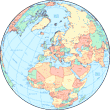 The educated Portuguese of the 15th century and the ancient
Greek mathematicians were well aware that the Earth was round, but they had
doubts about its diameter and were unfamiliar with the concept of gravity. Thus,
they believed they inhabited the top of the planet and that if they sailed too
far, they might fall into space. The Portuguese believed this point was just
beyond Cape Bojador (in present-day Western Sahara). The Portuguese navigator
Gil Eanes was persuaded by Prince Henry the Navigator to round it in 1434,
demonstrating that the Earth did not end there. For decades, the Portuguese
gradually established trading posts along the west coast of Africa, increasingly
southward. When they crossed the equator in the 1470s, they began to understand
that they would not fall into space. Thus, the Portuguese navigators discovered
the concept of gravity long before Newton.
The educated Portuguese of the 15th century and the ancient
Greek mathematicians were well aware that the Earth was round, but they had
doubts about its diameter and were unfamiliar with the concept of gravity. Thus,
they believed they inhabited the top of the planet and that if they sailed too
far, they might fall into space. The Portuguese believed this point was just
beyond Cape Bojador (in present-day Western Sahara). The Portuguese navigator
Gil Eanes was persuaded by Prince Henry the Navigator to round it in 1434,
demonstrating that the Earth did not end there. For decades, the Portuguese
gradually established trading posts along the west coast of Africa, increasingly
southward. When they crossed the equator in the 1470s, they began to understand
that they would not fall into space. Thus, the Portuguese navigators discovered
the concept of gravity long before Newton.
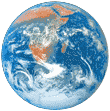
The first photograph of Earth from space was taken on October 24, 1946, by a camera aboard a modified German V-2 rocket launched by the United States, offering a view of clouds from space. Since 1959, satellites have been launched to photograph Earth from space. In April 1961, Russian cosmonaut Yuri Gagarin became the first human to view Earth from space. The first color photographs of the Earth as a whole were taken in 1967 by the DODGE satellite. However, the iconic image known as the "Blue Marble" was taken on December 9, 1972, by the astronauts of the Apollo 17 mission.
The Earth's surface can be subdivided into large continental masses: Africa, Antarctica, Asia, Europe, America and the Pacific Islands. These continents are bordered by five major bodies of water: the Arctic, Atlantic, Indian, Pacific, and Antarctic Oceans.