Madagascar, Africa (right), the world's fourth largest island. The narrow strip of green along the east coast of the island is a rain forest. The west coast is lined with baobabs, a desert tree with a fat trunk, and thorny forest (NASA, Terra satellite - September, 2003).


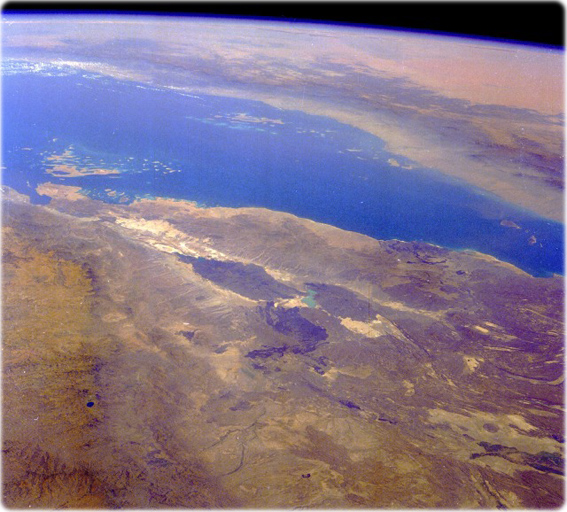
The lake basin, a landform in which a block of the Earth’s crust dropped down between blocks that rise on either side, began to form nearly 25 million years ago as part of the Great Rift Valley (NASA, 1985).


The lake basin, a landform in which a block of the Earth’s crust dropped down between blocks that rise on either side, began to form nearly 25 million years ago as part of the Great Rift Valley (NASA, 1985).


The lake basin, a landform in which a block of the Earth’s crust dropped down between blocks that rise on either side, began to form nearly 25 million years ago as part of the Great Rift Valley (NASA, 1985).


Nile River


Lake Tanganyika, Tanzania, Dem. Republic of Congo and Zambia (image below). This east-looking photograph features Lake Tanganyika, the second deepest freshwater lake in the world with a maximum depth of 1436 m and the longest lake in the world, stretching 660 km north to south. Its width varies between 16 and 72 km. The lake, bordered on either side by steep slopes, fills a long narrow trough in the western arm of Africa’s Great Rift Valley and supports a thriving fishing industry.


Red Sea. The coast of Sudan and Eritrea, Africa, can be seen in the bottom of this image. Saudi Arabia, in Asia, is on the other side (NASA).


Lake Tanganyika, Tanzania, Dem. Republic of Congo and Zambia (image below). This east-looking photograph features Lake Tanganyika, the second deepest freshwater lake in the world with a maximum depth of 1436 m and the longest lake in the world, stretching 660 km north to south. Its width varies between 16 and 72 km. The lake, bordered on either side by steep slopes, fills a long narrow trough in the western arm of Africa’s Great Rift Valley and supports a thriving fishing industry.


Lake Tanganyika, Tanzania, Dem. Republic of Congo and Zambia (image below). This east-looking photograph features Lake Tanganyika, the second deepest freshwater lake in the world with a maximum depth of 1436 m and the longest lake in the world, stretching 660 km north to south. Its width varies between 16 and 72 km. The lake, bordered on either side by steep slopes, fills a long narrow trough in the western arm of Africa’s Great Rift Valley and supports a thriving fishing industry.


Lake Tanganyika, Tanzania, Dem. Republic of Congo and Zambia (image below). This east-looking photograph features Lake Tanganyika, the second deepest freshwater lake in the world with a maximum depth of 1436 m and the longest lake in the world, stretching 660 km north to south. Its width varies between 16 and 72 km. The lake, bordered on either side by steep slopes, fills a long narrow trough in the western arm of Africa’s Great Rift Valley and supports a thriving fishing industry.


Grand Erg Occidental (right), North Central Algeria. This sand dune region of north-central Algeria is the large sandy-looking area in the center of the photo. This true desert region receives less than 25 cm of rainfall per year. The dark features to the southeast are the northwestern edge of the Tademait Plateau. The small dark specks near the southern edge of the photograph are very small oases and a few isolated circular field patterns (center-pivot irrigated fields). Immediately south of the large sand dunes region are several playas (dry lakebeds) where surface deposits of salt produce a highly reflective surface. The darker landforms near the western side of the photograph are slightly elevated bedrock outcrops whose ridge lines average 610 m above sea level. Near the horizon, the eastern end of the Atlas Mountains is barely discernible (NASA - April 1994).


Grand Erg Occidental (right), North Central Algeria. This sand dune region of north-central Algeria is the large sandy-looking area in the center of the photo. This true desert region receives less than 25 cm of rainfall per year. The dark features to the southeast are the northwestern edge of the Tademait Plateau. The small dark specks near the southern edge of the photograph are very small oases and a few isolated circular field patterns (center-pivot irrigated fields). Immediately south of the large sand dunes region are several playas (dry lakebeds) where surface deposits of salt produce a highly reflective surface. The darker landforms near the western side of the photograph are slightly elevated bedrock outcrops whose ridge lines average 610 m above sea level. Near the horizon, the eastern end of the Atlas Mountains is barely discernible (NASA - April 1994).


Grand Erg Occidental (right), North Central Algeria. This sand dune region of north-central Algeria is the large sandy-looking area in the center of the photo. This true desert region receives less than 25 cm of rainfall per year. The dark features to the southeast are the northwestern edge of the Tademait Plateau. The small dark specks near the southern edge of the photograph are very small oases and a few isolated circular field patterns (center-pivot irrigated fields). Immediately south of the large sand dunes region are several playas (dry lakebeds) where surface deposits of salt produce a highly reflective surface. The darker landforms near the western side of the photograph are slightly elevated bedrock outcrops whose ridge lines average 610 m above sea level. Near the horizon, the eastern end of the Atlas Mountains is barely discernible (NASA - April 1994).


Egypt, Africa and Mediterranean Sea (NASA).


Namib Desert Coast (above), Namibia (NASA).


Red Sea (NASA)


Africa Images


Namib Desert Coast (above), Namibia (NASA).


Africa Globo


The Earth as seen by the Apollo 17 crew traveling toward the moon (right). This translunar coast photograph extends from the Mediterranean Sea area to the Antarctica south polar ice cap. This is the first time the Apollo trajectory made it possible to photograph the south polar ice cap. (NASA - December 7, 1972).


Africa - Planet Earth

Globe Images

Travel to Africa

Images of Africa from Space

Egypt Africa


Saudi Arabia
Sudan


Africa Map

Tanzania, Congo and Zambia


Gibraltar


Africa Images


Google

Namibia Africa


Africa Image

Algeria Africa

Africa Maps

Gibraltar


sahara

Western Sahara


All rights reserved