
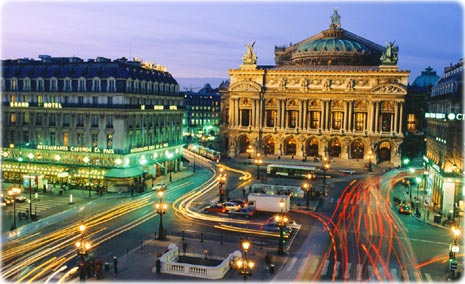
Place de L'Opera and the Garnier's Paris Opera, built between 1862-1875, by the architect Charles Garnier. The Opera House has a vast stage, with room for up to 450 artists and 2,200 seats. The auditorium's ceiling was painted by Chagall, in 1964. See more Pictures of Paris ►
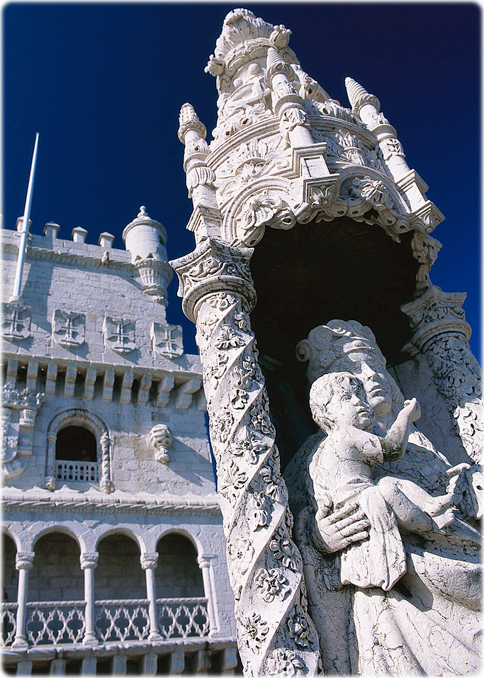
The Tower of Belem, with the Virgin Mary and Jesus, in Lisbon, Portugal. The Portuguese were the greatest explorers of the seas in the 15th century, beginning a new era in human history. It was the first major world power, with territories in four continents. The Spanish, British, French and Dutch followed Portugal in their achievements, using the Lusitanian technology.
 Europe
is the smallest of the world’s continents and occupy nearly one-fifteenth of the
world’s total land area, located entirely in the Northern Hemisphere. Its
maritime borders consist of the Arctic Ocean to the north, the Atlantic Ocean to
the west and the Mediterranean, Black and Caspian Seas to the south. The
southern regions are more mountainous, while moving north the terrain descends
from the high Alps, Pyrenees and Carpathians, through hilly uplands, into broad,
low northern plains, which are vast in the east. Sub-regions include Iceland,
Great Britain, Ireland and other islands.
Europe
is the smallest of the world’s continents and occupy nearly one-fifteenth of the
world’s total land area, located entirely in the Northern Hemisphere. Its
maritime borders consist of the Arctic Ocean to the north, the Atlantic Ocean to
the west and the Mediterranean, Black and Caspian Seas to the south. The
southern regions are more mountainous, while moving north the terrain descends
from the high Alps, Pyrenees and Carpathians, through hilly uplands, into broad,
low northern plains, which are vast in the east. Sub-regions include Iceland,
Great Britain, Ireland and other islands.
European culture, although diverse in many aspects, has its roots primarily in ancient Greece and the Roman Empire. In the Middle Ages, it was highly influenced by Christianity.
European Countries
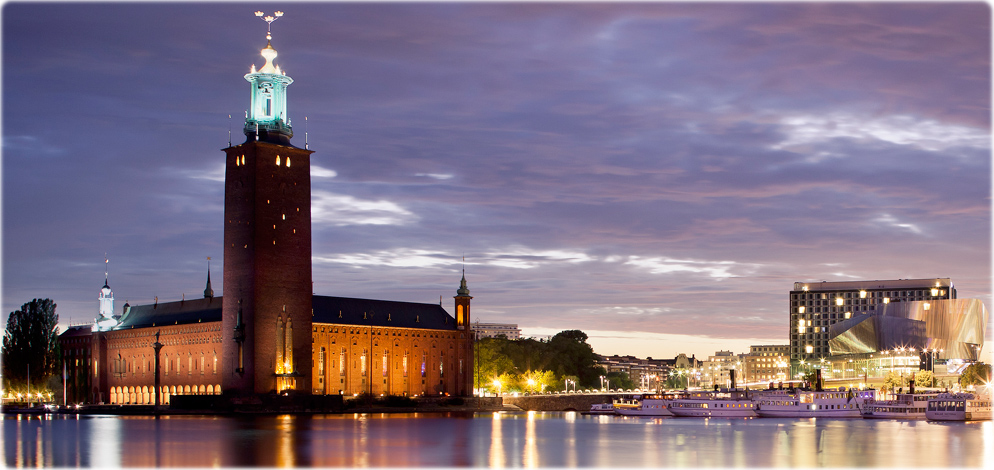
Stockholm City Hall is the venue of the Nobel Prize banquet and one of Stockholm's major tourist attractions. Designed by architect Ragnar Östberg, City Hall was constructed between 1911 and 1922.

|
Copyright © Geographic Guide - World in Pictures. European continent. |


Werner Nystrand
