Travel Guide Yerevan Armenia Europe Medieval Monasteries
Information, pictures, sites and maps about Armenia Europe. Capital Yerevan, travel guide Sacred Sites ofArmenia Facts about the country, cities tours, tourist information site visa, architecture city guide and best sites. hotels search guides ofeurope, cit y trevel. gp peopl e internet sightseeing an d tourism, hotel hostel. countr y econom geograph. visit museums, theaters, how to go things to do fo. Informatio n, picture s, site ans map s abou t Armeni a Europ e. Capital Yereva n, trvel guidw church medieva l tours, tourism.
Armenia
prides
itself
on
being
the
first
nation
to
formally
adopt
Christianity
(early
4th
century).
Despite
periods
of
autonomy,
over
the
centuries
Armenia
came
under
the
sway
of
various
empires
including
the
Roman,
Byzantine,
Arab,
Persian,
and
Ottoman.
It
was
incorporated
into
Russia
in
1828
and
the
USSR
in
1920.
|

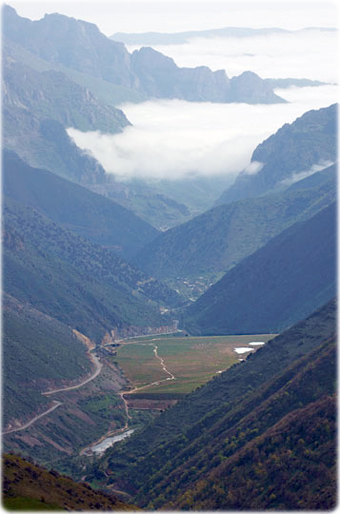
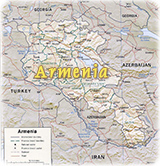
GeographyCountry name: Republic of Armenia (local: Hayastani Hanrapetut'yun). Capital: Yerevan. Government type: republic. Constitution adopted by nationwide referendum 5 July 1995. Independence: 21 September 1991 (from Soviet Union). Administrative divisions: 11 provinces (marzer, singular - marz); Aragatsotn, Ararat, Armavir, Geghark'unik', Kotayk', Lorri, Shirak, Syunik', Tavush, Vayots' Dzor, Yerevan. Terrain: Armenian Highland with mountains; little forest land; fast flowing rivers; good soil in Aras River valley. landlocked in the Lesser Caucasus Mountains; Sevana Lich (Lake Sevan) is the largest lake in this mountain range Total area: 29,800 kmē. Highest point: Aragats Lerrnagagat' 4,090 m (lowest point: Debed River 400 m). Climate: highland continental, hot summers, cold winters. |
|
|
|
GeographyCountry name: Republic of Armenia (local: Hayastani Hanrapetut'yun). Capital: Yerevan. Government type: republic. Constitution adopted by nationwide referendum 5 July 1995. Independence: 21 September 1991 (from Soviet Union). Administrative divisions: 11 provinces (marzer, singular - marz); Aragatsotn, Ararat, Armavir, Geghark'unik', Kotayk', Lorri, Shirak, Syunik', Tavush, Vayots' Dzor, Yerevan. Terrain: Armenian Highland with mountains; little forest land; fast flowing rivers; good soil in Aras River valley. landlocked in the Lesser Caucasus Mountains; Sevana Lich (Lake Sevan) is the largest lake in this mountain range Total area: 29,800 kmē. Highest point: Aragats Lerrnagagat' 4,090 m (lowest point: Debed River 400 m). Climate: highland continental, hot summers, cold winters. |
Travel Guide Yerevan Armenia Europe Medieval Monasteries
Information, pictures, sites and maps about Armenia Europe. Capital Yerevan, travel guide Sacred Sites ofArmenia Facts about the country, cities tours, tourist information site visa, architecture city guide and best sites. hotels search guides ofeurope, cit y trevel. gp peopl e internet sightseeing an d tourism, hotel hostel. countr y econom geograph. visit museums, theaters, how to go things to do fo. Informatio n, picture s, site ans map s abou t Armeni a Europ e. Capital Yereva n, trvel guidw church medieva l tours, tourism.


EconomyUnder the old Soviet central planning system, Armenia had developed a modern industrial sector, supplying machine tools, textiles, and other manufactured goods to sister republics in exchange for raw materials and energy. Since the implosion of the USSR in December 1991, Armenia has switched to small-scale agriculture away from the large agroindustrial complexes of the Soviet era. The agricultural sector has long-term needs for more investment and updated technology. The privatization of industry has been at a slower pace, but has been given renewed emphasis by the current administration. Armenia is a food importer, and its mineral deposits (copper, gold, bauxite) are small. The ongoing conflict with Azerbaijan over the ethnic Armenian-dominated region of Nagorno-Karabakh and the breakup of the centrally directed economic system of the former Soviet Union contributed to a severe economic decline in the early 1990s. By 1994, however, the Armenian Government had launched an ambitious IMF-sponsored economic liberalization program that resulted in positive growth rates in 1995-2003. Armenia joined the WTO in January 2003. Armenia also has managed to slash inflation, stabilize the local currency (the dram), and privatize most small- and medium-sized enterprises. The chronic energy shortages Armenia suffered in the early and mid-1990s have been offset by the energy supplied by one of its nuclear power plants at Metsamor. Armenia is now a net energy exporter, although it does not have sufficient generating capacity to replace Metsamor, which is under international pressure to close. The electricity distribution system was privatized in 2002. Armenia's severe trade imbalance has been offset somewhat by international aid and foreign direct investment. Economic ties with Russia remain close, especially in the energy sector. Currency: dram (AMD). Drams / US dollar = 578.76 (2002). GDP (purchasing power parity): US$ 11.8 billion (2003 est.). GDP per capita (purchasing power parity): US$ 3,900 (2003 est.) Population below poverty line: 50% (2002 est.). |
By May 1994, when a cease-fire took hold, Armenian forces held not only Nagorno-Karabakh but also a significant portion of Azerbaijan proper. The economies of both sides have been hurt by their inability to make substantial progress toward a peaceful resolution. Turkey imposed an economic blockade on Armenia and closed the common border because of the Armenian occupation of Nagorno-Karabakh and surrounding areas.
Armenian leaders remain preoccupied by the long conflict with Muslim Azerbaijan over Nagorno-Karabakh, a primarily Armenian-populated region, assigned to Soviet Azerbaijan in the 1920s by Moscow. Armenia and Azerbaijan began fighting over the area in 1988; the struggle escalated after both countries attained independence from the Soviet Union in 1991.
|
|
All rights reserved |