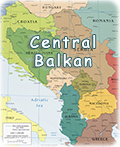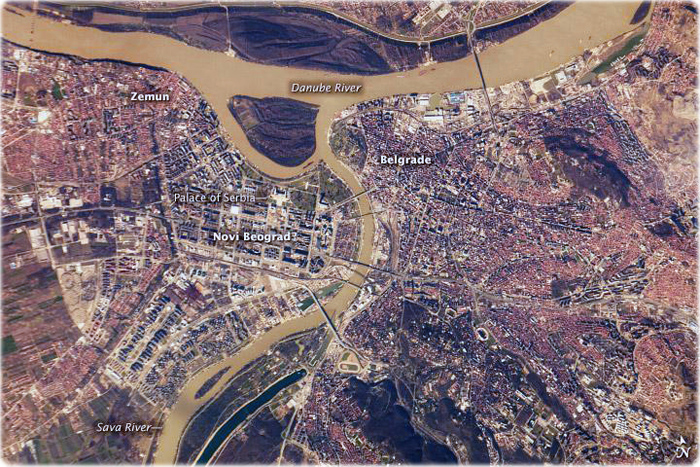
GeographyCountry name: Serbia and Montenegro (local: Srbija i Crna Gora). Capital: Belgrade. Government type: Republic. Administrative divisions: 2 republics (republike, singular - republika); and 2 nominally autonomous provinces (autonomn pokrajine, singular - autonomna pokrajina); Kosovo, Montenegro, Serbia, Vojvodina. Terrain: extremely varied; to the north, rich fertile plains; to the east, limestone ranges and basins; to the southeast, ancient mountains and hills; to the southwest, extremely high shoreline with no islands off the coast. Total area: 102,350 km˛. Coastline: 199 km. Highest point: Daravica 2,656 m. Climate: in the north, continental climate (cold winters and hot, humid summers with well distributed rainfall); central portion, continental and Mediterranean climate; to the south, Adriatic climate along the coast, hot, dry summers and autumns and relatively cold winters with heavy snowfall inland. Ports and harbors: Bar, Belgrade, Kotor, Novi Sad, Pancevo, Tivat, Zelenika. |
EconomyMilosevic-era mismanagement of the economy, an extended period of economic sanctions, and the damage to Yugoslavia's infrastructure and industry during the NATO airstrikes in 1999 have left the economy only half the size it was in 1990. After the ousting of former Federal Yugoslav President MILOSEVIC in October 2000, the Democratic Opposition of Serbia (DOS) coalition government implemented stabilization measures and embarked on an aggressive market reform program. After renewing its membership in the IMF in December 2000, Yugoslavia continued to reintegrate into the international community by rejoining the World Bank (IBRD) and the European Bank for Reconstruction and Development (EBRD). A World Bank-European Commission sponsored Donors' Conference held in June 2001 raised $1.3 billion for economic restructuring. An agreement rescheduling the country's $4.5 billion Paris Club government debts was concluded in November 2001; it wrote off 66% of the debt. The smaller republic of Montenegro severed its economy from federal control and from Serbia during the Milosevic era and continues to maintain its own central bank, uses the euro instead of the Yugoslav dinar as official currency, collects customs tariffs, and manages its own budget. Kosovo, while technically still part of the Federal Republic of Yugoslavia (now Serbia and Montenegro) according to United Nations Security Council Resolution 1244, is largely autonomous under United Nations Interim Administration Mission in Kosovo (UNMIK) and is greatly dependent on the international community and the diaspora for financial and technical assistance. The euro and the Yugoslav dinar are official currencies, and UNMIK collects taxes and manages the budget. The complexity of Serbia and Montenegro political relationships, slow progress in privatization, legal uncertainty over property rights, and scarcity of foreign-investment are holding back Serbia and Montenegro's economy. Arrangements with the IMF, especially requirements for fiscal discipline, are an important element in policy formation. Severe unemployment remains a key political economic problem. GDP (purchasing power parity): US$ 23.89 billion (2003). GDP per capita (purchasing power parity): US$ 2,200 (2003). GDP growth rate: 1.5 % (2003). Unemployment rate: 34.5 % (2003). Currency: in Serbia the Serbian dinar (CSD) is legal tender, but the euro (EUR) is the de facto currency; in Montenegro and Kosovo the euro is legal tender. Industries: machine building (aircraft and automobiles; weapons; electrical equipment; agricultural machinery); metallurgy; mining (coal, bauxite, nonferrous ore, iron ore, limestone); consumer goods (textiles, footwear, foodstuffs, appliances); electronics, petroleum products and chemicals. |
PeoplePopulation: 10.8 million (July 2004). Population growth rate: 0.03 % (2004).Life expectancy at birth: 74.4 years. Religions: Orthodox 65%, Muslim 19%, Roman Catholic 4%, Protestant 1%, other 11%. Ethnic groups: Serb 62.6%, Albanian 16.5%, Montenegrin 5%, Hungarian 3.3%, other 12.6% (1991). Languages: Serbian 95%, Albanian 5%. Nationality: noun: Serb(s); Montenegrin(s). Adjective: Serbian; Montenegrin. |
The
Kingdom of Serbs, Croats, and Slovenes was formed in 1918; its name was changed
to Yugoslavia in 1929. Occupation by Nazi Germany in 1941 was resisted by
various paramilitary bands that fought each other as well as the invaders. The
group headed by Marshal Tito took full control upon German expulsion in 1945.
Although Communist, his new government and its successors (he died in 1980)
managed to steer their own path between the Warsaw Pact nations and the West for
the next four and a half decades.
The remaining republics of Serbia and Montenegro declared a new "Federal Republic of Yugoslavia" (FRY) in April 1992 and, under President Slobodan Milosevic, Serbia led various military intervention efforts to unite ethnic Serbs in neighboring republics into a "Greater Serbia." All of these efforts were unsuccessful and led to Yugoslavia being ousted from the UN in 1992. In 1999, massive expulsions by FRY forces and Serb paramilitaries of ethnic Albanians living in Kosovo provoked an international response, including the NATO bombing of Serbia and the stationing of NATO, Russian, and other peacekeepers in Kosovo. Federal elections in 2000, brought about the ouster of Milosevic and installed Vojislav Kostunica as president. The arrest of Milosevic in 2001 allowed for his subsequent transfer to the International Criminal Tribunal for the Former Yugoslavia in The Hague to be tried for crimes against humanity. In 2001, the country was accepted into UN organizations under the name of Yugoslavia. Kosovo has been governed by the UN Interim Administration Mission in Kosovo, since June 1999. In February 2003, Serbia and Montenegro became a federation of two republics. An agreement was reached to permit a referendum in each republic in three years on full independence.
GeographyCountry name: Serbia and Montenegro (local: Srbija i Crna Gora). Capital: Belgrade. Government type: Republic. Administrative divisions: 2 republics (republike, singular - republika); and 2 nominally autonomous provinces (autonomn pokrajine, singular - autonomna pokrajina); Kosovo, Montenegro, Serbia, Vojvodina. Terrain: extremely varied; to the north, rich fertile plains; to the east, limestone ranges and basins; to the southeast, ancient mountains and hills; to the southwest, extremely high shoreline with no islands off the coast. Total area: 102,350 km˛. Coastline: 199 km. Highest point: Daravica 2,656 m. Climate: in the north, continental climate (cold winters and hot, humid summers with well distributed rainfall); central portion, continental and Mediterranean climate; to the south, Adriatic climate along the coast, hot, dry summers and autumns and relatively cold winters with heavy snowfall inland. Ports and harbors: Bar, Belgrade, Kotor, Novi Sad, Pancevo, Tivat, Zelenika. |
In the early 1990s, post-Tito Yugoslavia began to unravel along ethnic lines: Slovenia, Croatia, The Former Yugoslav Republic of Macedonia, and Bosnia and Herzegovina were recognized as independent states in 1992.


|
All rights reserved |